

How it works
Occlusion sensitivity
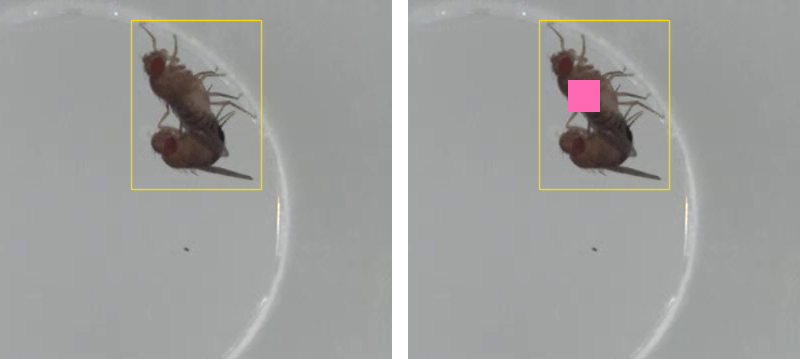
Replace one region of the frame at a time with a baseline and record how the detection's score changes. The result is a perturbation effect, mapped.
Definition
For a rectangle R of the frame x, replaced by a baseline b:
Δ(R) = s_ref − s(x with R replaced by b)
- s_ref is the detection’s score on the unchanged frame, evaluated at the run’s batch size. At batch size 1 (the default) it is the confidence YORU reports.
- Patches of
patch_sizetile the region withstride; the last row and column are aligned to the region’s edge so that every pixel is covered. - The map gives each pixel the mean Δ of the counted patches covering it, and NaN where no counted patch covers it. A patch is counted when its score exists (
ok,matched;ambiguousonly on request). - Signs are kept. Δ > 0: hiding R lowers the score. Δ < 0: hiding R raises it.
Controls
Every target is also run through two controls:
| Control | What it is | Expected |
|---|---|---|
noop |
the unchanged frame, through the same batch pipeline | Δ exactly 0 — checks the pipeline on every target |
full_region |
the whole region replaced by the baseline | the score with everything around the detection hidden |
In the run above, noop gave Δ = 0.0, and replacing the whole region lowered the copulation score from 0.896 to 1.3 × 10⁻⁸.
Baselines
| Baseline | An occluded patch becomes |
|---|---|
constant (default) |
one B,G,R colour: hot pink #FF69B4 (180,105,255) by default; black (0,0,0); YOLOv5’s letterbox grey (114,114,114); or any colour |
image_mean |
the frame’s mean colour |
patch_mean |
the patch’s own mean colour: removes texture, keeps colour |
blur |
the same patch of a Gaussian-blurred frame (sigma): removes detail, keeps colour |
noise |
uniform random colours, seeded per patch |
Each patch’s real pixel change is recorded (pixel_change): a patch that changes no pixel cannot have an effect.
The effect depends on the baseline
Occlusion edits the frame into something the model never saw. Black over a bright arena is extreme. The default hot pink is strongly red — and a fly’s eyes are red — so a pink patch may add eye-like evidence as well as hide what it covers. The size of the effect also depends on the patch size and the stride. Compare settings before drawing conclusions.
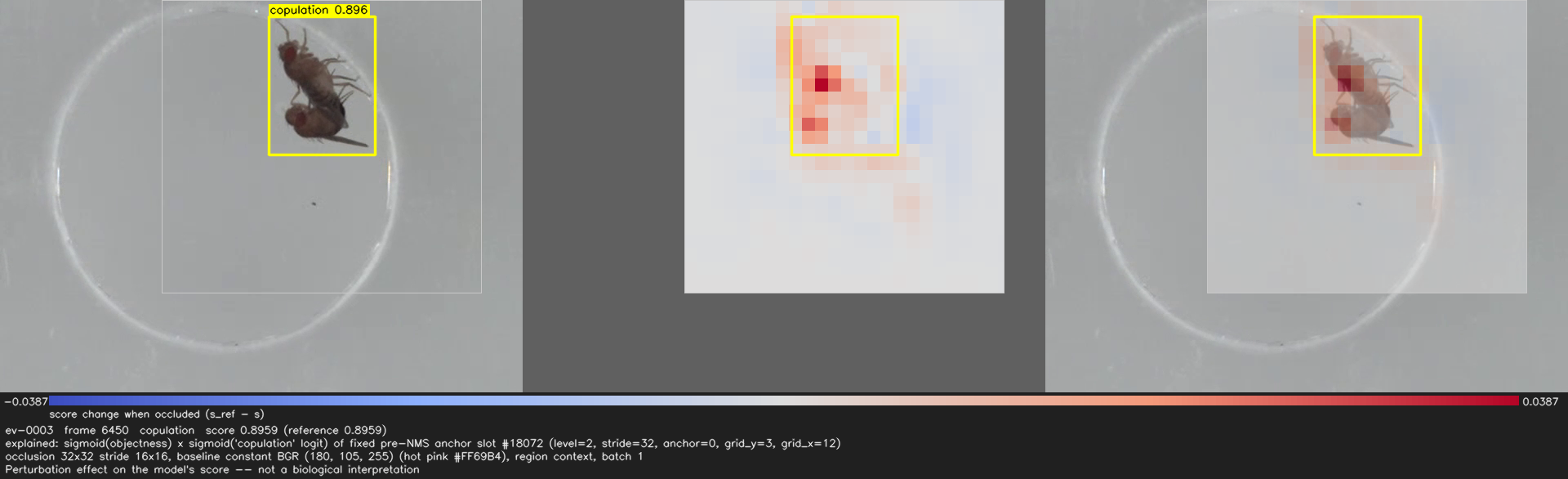
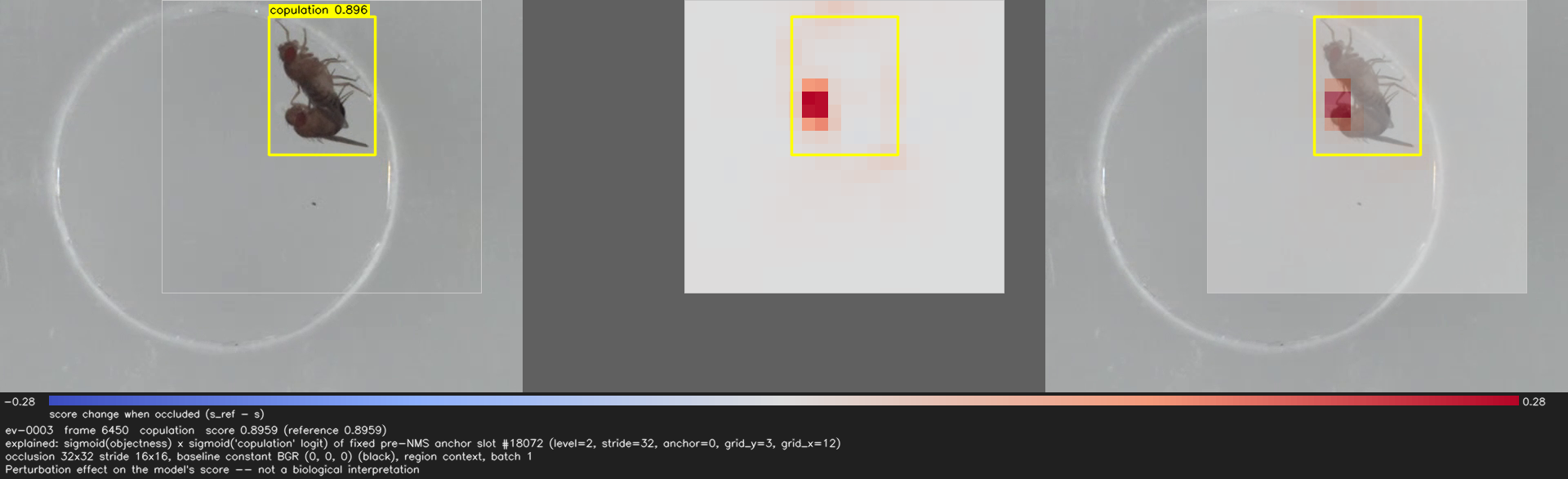
The same copulation event with the default hot pink and with black, all other settings equal:
| Baseline | Largest Δ | Mean Δ in the box | Mean Δ outside | Patches where NMS dropped the candidate |
|---|---|---|---|---|
| hot pink | 0.055 | 0.0066 | −0.0003 | 0 of 528 |
| black | 0.523 | 0.029 | 0.0019 | 2 of 528 |
The largest drop with pink patches is about a tenth of the largest drop with black ones, although the largest effects sit in the same place. A figure should name its baseline; a claim should show more than one.
Batch size
A detector’s scores depend slightly on how many frames are processed together, because different GPU and CPU kernels are used: up to 2.4 × 10⁻³ between batch sizes 1 and 4 on CUDA with fp16 autocast, 2 × 10⁻⁶ on the CPU. YORU-Explain therefore takes the reference score at the run’s batch size, which keeps the noop control at exactly 0. Still, per-patch changes at batch size 8 differ from those at batch size 1 by up to 2.7 × 10⁻³ on the fly model, so effects smaller than that are not resolved at batch sizes above 1. Batch size 1 is exact.
Every batch is padded to the same size. A CUDA out-of-memory error fails the event with cuda_oom; the batch size is never changed silently during a run.
Fixed-candidate and re-detection in occlusion
- Fixed-candidate: every patch has a score. The run also counts the patches after which NMS would no longer keep the candidate (candidate dropped) and records how far the candidate’s box moved.
- Re-detection: a patch after which the detection is not found again (
disappeared,class_changed,unmatched,ambiguous) has no score and is not counted. Pixels covered only by such patches are NaN in the map, andlost_fractionin the map file shows where that happened.
Definitions of each column: Output files.