
How it works
Grad-CAM
A gradient-weighted feature map of the detection's score — an attribution, offered only for models whose gradient path was verified.
Definition
For the candidate’s score s and the feature map A of a layer (channels c, cells i, j):
α_c      = mean over i, j of  ∂s / ∂A_c(i, j)
CAM      = Σ_c  α_c · A_c
Grad-CAM = max(CAM, 0)
The map file keeps both: cam_feature, the signed CAM on the layer’s grid, and cam, the ReLU upsampled bilinearly (cell (i, j) centred on input pixel ((j+½)s, (i+½)s)), cropped by the input padding and resized to the frame.
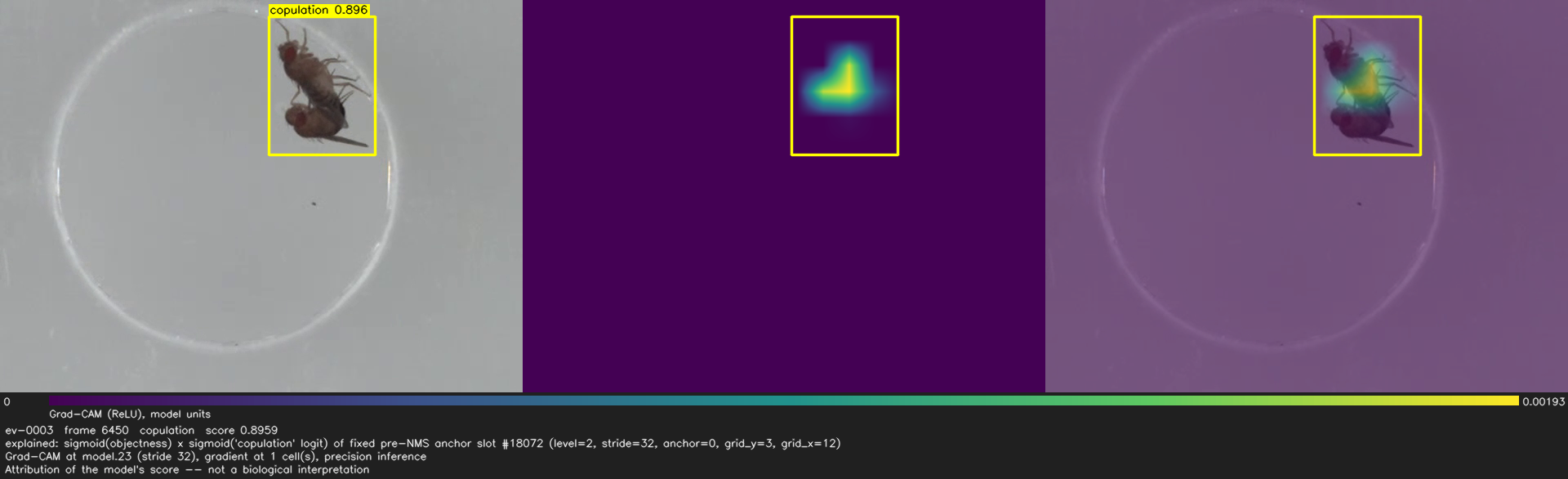
model.23, stride 32). Left to right: the frame, the map, the map over the frame. 99.9% of the map's mass lies in the box.Which layer
By default, the feature map the candidate’s score is computed from:
| Family | Default layer |
|---|---|
| YOLOv5 | the input of the Detect head at the candidate’s own level (model.17, model.20 or model.23 for v5s-sized models) |
| YOLOv8, YOLO11, YOLOv5u, YOLOv10 | the head’s input at the candidate’s level (YOLOv10: through the one-to-one branch that produced the score) |
| RT-DETR | the decoder input at the level of the query’s encoder token |
| Faster / Mask R-CNN | the FPN level the proposal is pooled from |
| SSD | the backbone level of the default box |
| ONNX, black box | none: no gradients |
Other layers whose maps tile the input can be chosen in Analyze. On one frame a query or a proposal is a well-defined candidate, so Grad-CAM is offered for RT-DETR and Faster R-CNN although fixed-candidate occlusion is not.
When a map is made
A map is produced only if
- the gradient probe passed when the model was loaded;
- the target has its candidate;
- the score in the gradient pass equals the inference score (within
score_tolerance, 10−4; the measured difference is 0); - the gradient is finite and not zero everywhere;
- the map is finite.
Otherwise the result is failed, with an error code and no map.
The model is never changed
Grad-CAM never puts a model in training mode and never changes its weights; the gradients are taken with respect to activations, from a copy of the input. After every Grad-CAM test the weights (state-dict SHA-256), the evaluation mode of every module and the detections were unchanged, and no parameter had a gradient.
Where the gradient reaches
gradient_support in results.csv is the number of cells of the layer where the score’s gradient is not zero. It decides what the map can show.
YOLOv5’s Detect head is a 1×1 convolution, so at its input the gradient is non-zero at exactly one cell. The map then shows where the channels that cell relies on are active anywhere in the frame — on another fly of the same class as much as on the target:
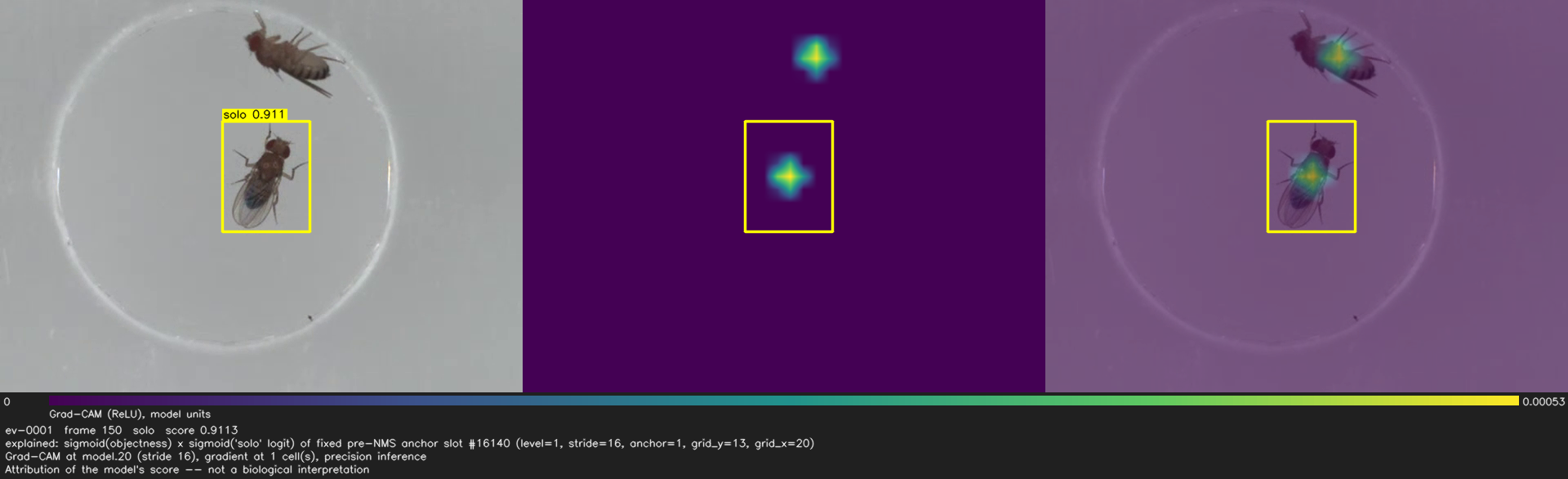
model.20, gradient at 1 cell). The map is as bright on the other fly as on the detected one: 50% of its mass lies in the box. The same happens for the second fly. This is what the method measures here, not a failure.Other heads spread the gradient over more cells (measured on the test models):
| Model | Default layer (stride) | Cells with gradient |
|---|---|---|
| YOLOv5 | model.23 (32) |
1 |
| YOLOv5, earlier layers | model.17, model.9 |
49–361 |
| YOLOv8n, YOLO11n, YOLOv5u, YOLOv10n (and seg, pose) | head input (32) | 25 |
| YOLO11n-OBB | model.16 (8) |
15 |
| RT-DETR-L | model.27 (32) |
342 |
| Faster R-CNN | backbone.fpn.2 (16) |
280 |
| Mask R-CNN | backbone.fpn.2 (16) |
252 |
| SSD300 | backbone.2 (32) |
9 |
Grad-CAM and occlusion are different measurements
Grad-CAM is an attribution: a statement about the gradient of the score at one layer. Occlusion is a perturbation effect: what happens to the score when the image is edited. They need not agree, and neither is the other’s ground truth. Sanity checks of Grad-CAM (weight randomisation) and per-event comparisons with occlusion are planned (Roadmap).